Emergency Callout
  Get in Contact
  Get Your Free Quote
 Industrial businesses across the UK rely on doors that improve security, efficiency, energy performance and operational reliability. That is why sectional overhead doors have become one of the most widely specified solutions for commercial and industrial premises.
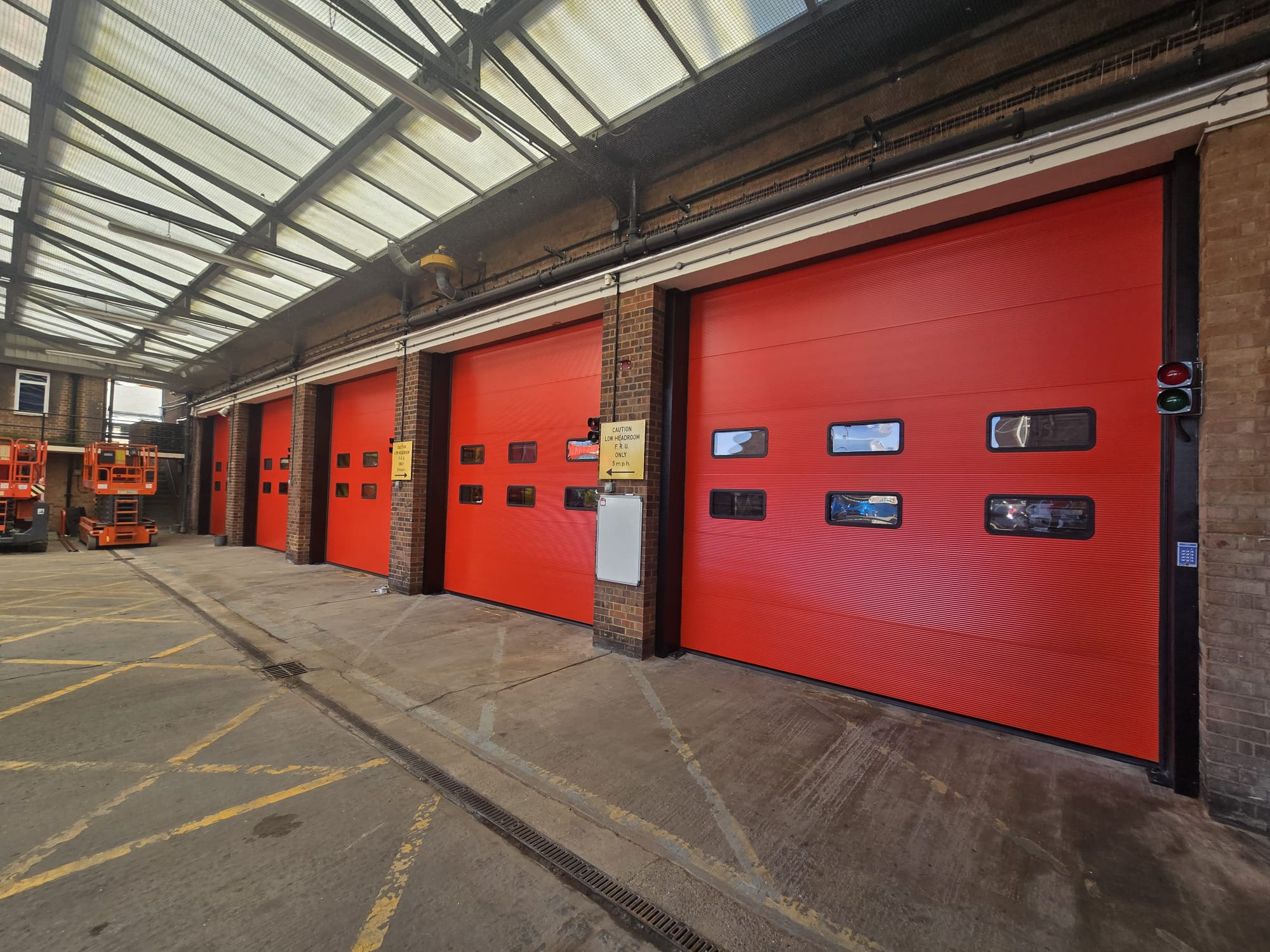
From logistics hubs and food productions facilities to fires stations and ambulance depots, sectional overhead doors are designed to cope with high traffic, demanding environments and strict safety requirements. Their combinations of durability, insulation and automations make them particularly attractive for organisations focused on reducing downtime and improving long-term efficiency.
As modern buildings place greater emphasis on sustainability, compliance and workplace safety, sectional doors continue to evolve with improved insulation values, smarter controls and enhanced safety systems. Trade bodies in the UK have also played a major role in raising standards across installation, maintenance and training throughout the industry.
What Is a Sectional Overhead Door?
A sectional overhead door is made up of multiple horizontal panels connected by hinges. Rather than swinging outward like a traditional door, the sections travel vertically upwards before sliding horizontally along ceiling-mounted tracks.
This design creates a compact and highly efficient opening system that maximises both internal and external space. Because the door lifts vertically, vehicles and pedestrians can move close to the opening without obstruction, which is particularly useful in busy industrial settings.
Sectional overhead doors are commonly manufactured using galvanised steel, aluminium or insulated composite panels. Depending on the application, they may also incorporate vision panels, high-speed motors, reinforced locking systems and smart access controls.
They are widely used in warehouses, manufacturing plants, loading bays, cold storage facilities, vehicle workshops and emergency service buildings.
Brief History of Sectional Overhead Doors
The development of sectional doors closely followed the growth of industrialisation and motor transport during the twentieth century. Early industrial buildings typically used large, hinged timber doors, but these required significant clearance space and were often difficult to operate efficiently.
As factories, warehouses and vehicle depots expanded, manufacturers developed vertically opening sectional systems that could save space and improve access. By the 1920s, overhead sectional doors had become increasingly popular, particularly after the introduction of electric operators that allowed automated opening and closing.
Post-war industrial growth across the UK accelerated demand for more durable and efficient door systems. Over time, advances in steel constructions, insulation and automation transformed sectional overhead doors into the high-performance systems used today in logistics centres, manufacturing plants and emergency services facilities.
Modern designs now incorporate improved thermal efficiency, advance safety systems and smart automation technology while still retaining the same core principles of providing reliable-space-saving industrial access.
Why Are Sectional Overhead Doors So Popular?
The popularity of sectional overhead doors come down to one key factor: versatility.
Industrial businesses need doors that can withstand constant use while supporting operational efficiency. Traditional outward-opening systems can create space restrictions, security weaknesses and heat loss. Sectional overhead doors solve many of these problems in a single design.
For emergency services, the need for reliability is even greater. Fire stations and ambulance depots require fast opening doors capable of performing repeatedly under pressure. Delays caused by poor access systems can directly affect response times, making dependable sectional overhead doors an essential part of operational readiness.
At the same time, many UK businesses are under increasing pressure to improve sustainability and reduce energy costs. Insulated sectional overhead doors help facilities maintain internal temperatures more effectively, lowering energy consumption and improving workplace comfort.
What Are the Main Benefits of Sectional Overhead Doors?
Space-Saving
One of the biggest advantages of sectional overhead doors is their efficient use of space.
Because the door rises vertically instead of swinging outward, vehicles can park much closer to the entrance without affecting operation. This is especially important in busy loading bays, distribution centres and emergency services where space is often limited.
Internally, the overhead track system also helps maximise usable floor area. Forklift routes, storage systems and workspaces can be planned more efficiently because there is no need to accommodate the swing arc of a conventional door.
Improved Thermal Insulation and Energy Efficiency
Energy efficiency had become a major consideration for UK industrial businesses, particularly with rising utility costs and sustainability targets.
Modern sectional overhead doors are typically built using insulated sandwich panels containing polyurethane or polystyrene cores. These insulated panels help minimise heat transfer and maintain stable internal temperatures.
This is particularly valuable in food production facilities, pharmaceutical sites, temperature-controlled storage and manufacturing environments where maintaining environmental conditions is critical.
Well insulated doors reduce drafts, improve thermal retention and help HVAC systems operate more efficiently. Over time, this can contribute to lower energy bills and reduced carbon emissions.
Increased Security
Security remains a critical concern for industrial premises, especially those storing valuable equipment, stock or vehicles.
Sectional overhead doors are designed with robust materials and reinforced construction that make forced entry more difficult. Advanced locking mechanisms, anti-lift devices and integrated access controls provide additional layers of protection.
For emergency services, secure access is essential for protecting specialist vehicles and equipment while still allowing rapid deployment when required.
Reliability
Industrial facilities often operate around the clock, placing significant demands on access systems.
Sectional doors are specifically engineered for high-cycle use. Heavy duty springs, reinforced tracks and durable motors allow them to withstand constant operation in demanding environments.
This reliability is particularly important in distribution centres, freight depots, manufacturing plants and emergency response buildings where downtime can quickly disrupt operations.
High-speed sectional doors are also increasingly popular in logistics and cold chain operations where reducing opening times helps improve efficiency and maintain temperature control.
Are Sectional Overhead Doors Safe?
Safety is one of the most important considerations when selecting any industrial door system.
Modern sectional overhead doors are equipped with a wide range of built-in safety features designed to protect users, vehicles ad equipment. These may include obstacle detection sensors, finger trap protection, cable break devices and emergency manual releases.
In the UK, industrial and commercial doors are subject to strict safety requirements under BS EN 13241. Businesses also have wider responsibilities under the workplace legislation such as the Provision and Use of Work Equipment Regulations 1998 (PUWER), which requires equipment to be properly maintained and safe for use.
Importance of Regular Servicing and Maintenance
Even the highest quality sectional door requires ongoing maintenance.
Industrial doors are complex mechanical systems with moving components that experience wear over time. Springs, cables, rollers, motors and safety sensors all need regular inspection to ensure reliable and safe operation.
Routine servicing helps businesses reduce the risk of breakdowns, improve operational reliability and maintain safety compliance. It also allows potential issues to be identified before they develop into expensive failures or operational disruption.
For facilities with heavy usage, particularly logistics hubs and emergency service buildings, planned preventative maintenance is essential for ensuring continuous operation.
UK Trade Bodies and Industry Associations
Trade bodies and professional associations play an important role in maintaining standards across the industrial door sector.
The Door & Hardware Federation is one of the leading organisations within the UK industrial door industry. It provides technical guidance, training, safety information and support on compliance matters for companies involved in industrial doors, shutters and automated access systems.
Businesses often look for suppliers and maintenance providers associated with recognised trade bodies because membership demonstrated commitment to professional standards, compliance and ongoing training.
Choosing the Right Sectional Overhead Door
Not every sectional overhead door is the same, and selecting the right system depends on the operational requirements of the building
Factors such as frequency of use, thermal performance, opening speed, security requirements and available headroom all influence the specification process.
For example, a cold storage facility may prioritise insulation and rapid opening speeds, while a fire station may focus on reliability and response time optimisation.
Working with an experienced door installer who understands both operational demands and UK compliance standards is essential to ensuring the correct specification.