Emergency Callout
  Get in Contact
  Get Your Free Quote
 Keeping a commercial or industrial site secure is not always about high-tech security systems or imposing perimeter fencing.
Sometimes, the first line of defence is much simpler.
It is the entrance.
If vehicles can enter and leave your site without any form of control, you may have little idea who is coming and going. That can create problems for security, safety and day-to-day site management.
This is where automatic rising arm barriers can make a real difference.
What is an Automatic Rising Arm Barrier?
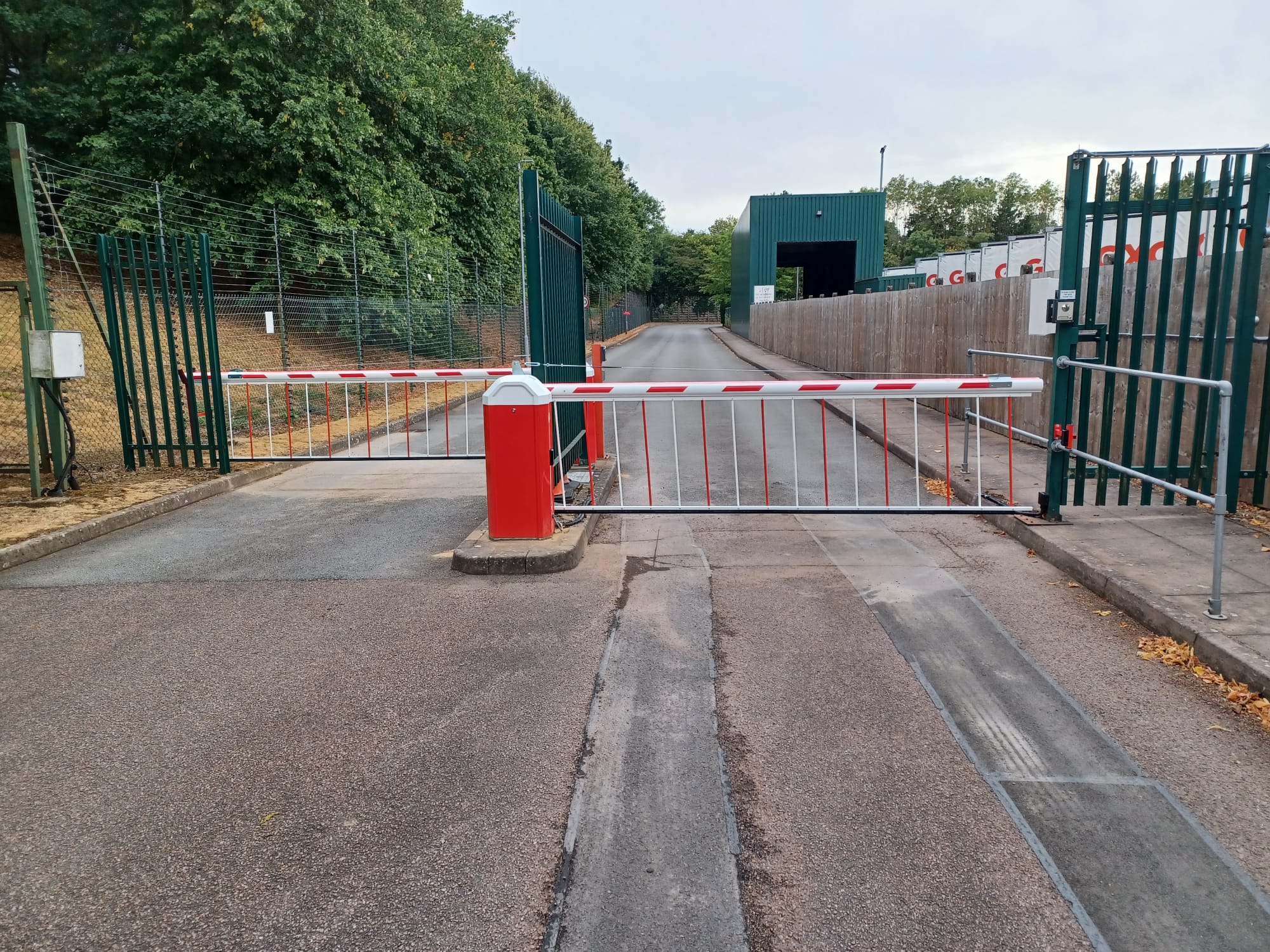
An automatic rising arm barrier is a powered vehicle access control system. It uses a horizontal arm that raises and lowers to control access through an entrance or exit.
When access is authorised, the barrier’s arm rises. Once the vehicle has passed, it lowers again.
The system can be operated in several ways. These can include remote controls, keypads, proximity cards, intercom systems, automatic number plate recognition (ANPR) and other access control technologies.
The right option depends on the site and how much control is required.
For a busy commercial site, for example, you may want authorised employees to enter using an access card. A visitor entrance might use an intercom or keypad. A car park could use ANPR to automatically identify approved vehicles.
The barrier itself is only one part of the system.
It can form part of a much wider access control strategy.
Control who enters your site
One of the biggest benefits of an automatic rising arm barrier is straightforward: it gives you greater control over vehicle access.
Without a barrier, a private car park, yard or industrial premises can be relatively easy to access.
That does not necessarily mean someone is going to break in. But unrestricted access makes it harder to manage who is using your site.
A barrier creates a physical point of control.
Authorised vehicles can be allowed through, while unauthorised vehicles can be stopped.
For businesses dealing with valuable equipment, stock, vehicles or sensitive information, that additional level of control can be important.
It can also provide peace of mind for site managers.
Deter unauthorised access
Security is not just about stopping an incident.
It is also about preventing one from happening in the first place.
A visible automatic barrier sends a clear message that access to the site is controlled.
This can be enough to discourage casual or opportunistic access.
Someone looking for an easy way onto a commercial site is far more likely to choose an open entrance than one protected by a barrier, security gates or other access control measures.
Of course, a barrier should not be viewed as a complete security solution on its own.
It works best alongside other measures such as perimeter fencing, CCTV, lighting, security doors and appropriate access procedures.
Think of it as another layer of protection.
Improved vehicle access control
Knowing who is entering your site is particularly important on larger commercial and industrial premises.
An automatic rising arm barrier can help you manage vehicle movements more effectively.
For example, employees could be provided with individual access credentials. Regular contractors could have their access restricted to certain times. Visitors could be required to check in before being allowed through the entrance.
This gives facilities managers greater control over the site.
It also makes it easier to adapt access arrangements when circumstances change.
An employee leaves the business? Their access can be removed.
A contractor only needs access for a week? Their permissions can be limited accordingly.
That is much more effective than handing out a physical key and hoping it is returned.
Help protect employees and visitors
Site security and site safety often go hand in hand.
Commercial premises can have a lot of vehicle movement. Warehouses, distribution centres, manufacturing facilities and construction sites may have cars, vans, HGVs and other vehicles using the same entrance.
Uncontrolled vehicle movements can create unnecessary risks.
An automatic barrier can help establish a defined entrance and exit point.
It can also be integrated with other systems to manage when vehicles are allowed to enter.
This can be particularly useful outside normal operating hours. For example, a site may operate 24 hours a day but only allow certain vehicles to enter overnight.
The barrier can help enforce those access rules.
Reduce the risk of theft
For many businesses, the threat of theft is a genuine concern.
That could mean stolen vehicles, tools, machinery, materials or stock.
An open site can make it easier for someone to drive in, load up and leave without attracting much attention.
An automatic barrier adds another obstacle.
It does not make theft impossible. Nothing does.
But it can make unauthorised access more difficult and more noticeable.
When combined with CCTV and other security measures, it can also help create a stronger overall deterrent.
For sites storing high-value goods or equipment, that can be particularly valuable.
Manage access outside normal working hours
Not every site operates from 9 to 5.
Factories, logistics facilities, warehouses, distribution centres and other commercial premises may operate around the clock.
Even sites that close at the end of the working day may still need occasional out-of-hours access.
An automatic rising arm barrier can provide controlled access without requiring someone to physically open and close a gate every time a vehicle arrives.
Access permissions can be set according to the needs of the site.
That means authorised employees or contractors can still gain access when required, while the entrance remains secure at other times.
This can also reduce the need for security staff to manually control every vehicle entering the site.
Keep traffic moving
Security is important. But so is keeping your site operational.
A security system that creates long queues every morning is unlikely to be popular with employees, visitors or delivery drivers.
One of the advantages of automatic rising arm barriers is that they can provide controlled access without necessarily slowing traffic down significantly.
Vehicles can be authorised quickly using systems such as proximity cards, keypads or ANPR.
Once access has been granted, the barrier rises and the vehicle can continue.
This makes them particularly suitable for busy entrances where security and convenience both matter.
Create a more professional first impression
Your site entrance says something about your business.
It is often one of the first things visitors, customers, suppliers and contractors see.
An organised and well-maintained entrance can create a more professional impression.
By contrast, an open entrance with unclear access arrangements can make a site feel less controlled.
An automatic rising arm barrier provides a clear indication that vehicle access is managed.
Integrate with other security systems
Modern access control does not have to operate in isolation. An automatic rising arm barrier can form part of a wider security system.
For example, it could work alongside CCTV to provide visual monitoring of vehicles entering and leaving the site.
It could also be integrated with ANPR technology.
ANPR uses cameras to identify vehicle registration numbers. Approved vehicles can then be granted access automatically.
This can be particularly useful for staff car parks, private developments, logistics sites and other locations where there are regular vehicle movements.
Other options include intercoms, keypads and card or fob-based access control.
The important thing is to choose a system that matches how your site operates.
There is little point installing a complicated system if your team does not need it.
Help create a clear audit trail
Depending on the access control system used, it may be possible to keep records of vehicle movements.
This can provide useful information for facilities managers and security teams.
For example, you may want to know when a particular vehicle entered the site or which access credentials were used.
Having this information can be helpful when investigating security incidents.
It can also help identify patterns.
Perhaps vehicles are regularly accessing an area outside normal working hours. Or perhaps a particular entrance is being used when it should not be.
Good security is not just about installing equipment.
It is also about having information that helps you understand what is happening on your site.
Where Are Automatic Rising Arm Barriers Commonly Used?
Automatic barriers can be used in many different environments.
These include:
- Industrial estates
- Warehouses and distribution centres
- Manufacturing facilities
- Commercial car parks
- Office developments
- Construction sites
- Retail parks
- Hospitals and healthcare facilities
- Schools and universities
- Public sector premises
- Residential developments
- Logistics and transport facilities
Every site is different. The barrier and access control system should therefore be selected based on factors such as traffic levels, opening width, operating hours, security requirements and the type of vehicles using an entrance.
What Should You Consider When Choosing a Barrier?
There is no single barrier that will be right for every site.
Before choosing a system, it is worth considering how the entrance is used on a typical day:
• How many vehicles use it?
• What type of vehicles are they?
• Is the site busy during certain periods?
• Does it need to operate 24/7?
• How will authorised vehicles gain access?
• Do you need ANPR?
• Will visitors need to contact someone before entering?
These questions can help determine the most suitable solution.
You should also consider the physical layout of the entrance.
Available space, road width, traffic flow and pedestrian routes can all affect the design.
Safety is another important consideration.
Automatic barriers need to be installed and maintained correctly, with appropriate safety features and controls for the environment in which they operate.
That is one reason why professional advice is important.
Are Automatic Barriers Enough to Secure a Site?
It is important to be realistic.
An automatic rising arm barrier is not a substitute for a complete security strategy. A determined intruder may find another way onto a site.
That is why barriers are usually most effective when combined with other security measures.
Depending on the site, these could include perimeter fencing, security gates, CCTV, security lighting, pedestrian access control, security doors and alarm systems.
The aim is to create layers of security.
If one measure is bypassed, another is still in place.
This approach can make it significantly harder for unauthorised individuals to access restricted areas.
Choosing the Right Access Control Solution
The best access control system is not necessarily the most complicated one.
It is the one that works for your site.
A small commercial premises may only require a straightforward barrier and remote control system.
A large distribution centre with hundreds of vehicle movements every day may benefit from a more sophisticated solution incorporating ANPR and automated access permissions.
The key is understanding what you are trying to achieve:
- Are you primarily looking to deter unauthorised access?
- Do you need to control employee and contractor access?
- Are you trying to improve car park management?
- Do you need to record vehicle movements?
- Or are you looking for a combination of all of these?
Once you understand the requirement, it becomes much easier to identify the right solution.
Improving Security Starts at the Entrance
Your entrance is the first point of contact between your site and the outside world.
It is also one of the most important points to control.
An automatic rising arm barrier can help you manage vehicle access, deter unauthorised entry, improve site safety and support a wider security strategy.
For facilities managers, the benefits can go beyond security too.
A well-designed system can help keep traffic moving, reduce the need for manual access control and make day-to-day site management easier.
The right solution will depend on your premises, your traffic levels and your security requirements.
If you are considering installing or upgrading an automatic rising arm barrier, it is worth speaking to an experienced access control specialist. They can assess your site and recommend a solution that provides the right balance between security, safety and ease of use.
At SDG Access, we provide a range of security and access control solutions for commercial and industrial sites across the UK. If you are looking to improve vehicle access to your premises, our team can help you identify a solution suited to your site.