Emergency Callout
  Get in Contact
  Get Your Free Quote
 Whether it’s a roller shutter protecting a warehouse, a sectional overhead door on a loading bay, or an automatic pedestrian door at a busy office, these doors can be opened and closed hundreds of times every week.
And like any mechanical equipment, they need looking after.
Regular servicing can help keep commercial doors safe, reliable and operational. It can also identify small problems before they become expensive repairs.
But how often should commercial and industrial doors be serviced?
The answer depends on the type of door, how frequently it is used and the environment in which it operates.
Why Do Commercial and Industrial Doors Need Servicing?
It can be tempting to leave a commercial door alone when it appears to be working normally.
If it opens, closes and locks, why would it need attention?
The problem is that mechanical faults do not always announce themselves straight away.
Components can wear gradually. Springs can weaken. Tracks can become damaged or misaligned. Safety devices can deteriorate. Motors and electrical components can develop faults.
The door may continue to operate, until suddenly it doesn’t!
A failed commercial door can cause more than an inconvenience. Depending on the site, it could prevent deliveries, restrict access, compromise security or create a safety issue.
Regular servicing provides an opportunity to inspect the door and identify potential problems before they become more serious.
How Often Should Doors Be Serviced?
There is no single servicing interval that applies to every commercial door.
The appropriate frequency depends on several factors, including:
- The type of door
- How often it is operated
- The environment in which it is installed
- The level of risk associated with failure
- The manufacturer’s recommendations
- The condition and age of the door
- The type of components and safety systems fitted
As a general rule, commercial and industrial doors should be inspected and maintained at appropriate intervals based on their use and risk.
A lightly used door in a clean environment may require less frequent attention than a heavily used loading bay door operating throughout the day.
For high-use doors, more frequent inspections may be appropriate.
This is why a professional assessment is preferable to simply applying the same servicing schedule to every door on a site.
What Is the Difference Between Servicing and Inspection?
The term “inspection” and “service” are sometimes used interchangeably but they are not necessarily the same thing.
An inspection generally involves checking the condition and operation of the door and its components.
A service goes further.
Depending on the door and its condition, servicing may involve cleaning, lubrication, adjustment and replacement of worn components, as well as testing safety features and the overall operation of the door.
A professional service should identify problems that may not be obvious during normal day-to-day use.
It is therefore important to understand what is included when arranging commercial door maintenance.
A company offering a “service” should be able to explain what will be checked and what work will be carried out.
High-Use Doors May Need More Frequent Servicing
One of the biggest factors affecting servicing frequency is usage.
A warehouse door that opens hundreds of times a day is experiencing considerably more wear than a door that is opened a handful of times each week.
High-traffic environments require a more proactive maintenance programme.
This is particularly relevant for logistics, manufacturing and distribution facilities where a failed door can have a direct impact on operations.
If vehicles cannot enter or leave a loading area, deliveries can quickly become delayed. That can have a knock-on effect across the business.
What Types of Commercial and Industrial Doors Need Servicing?
Most types of commercial and industrial doors benefit from regular inspection and maintenance including:
Roller shutters
Roller shutters are commonly used on commercial and industrial premises for security and access control.
They contain several moving components that can experience wear over time.
During servicing, an engineer may check areas such as the curtain, guides, bottom rails, bearings, springs, motor and control system.
The safety devices should also be checked where fitted.
Sectional overhead doors
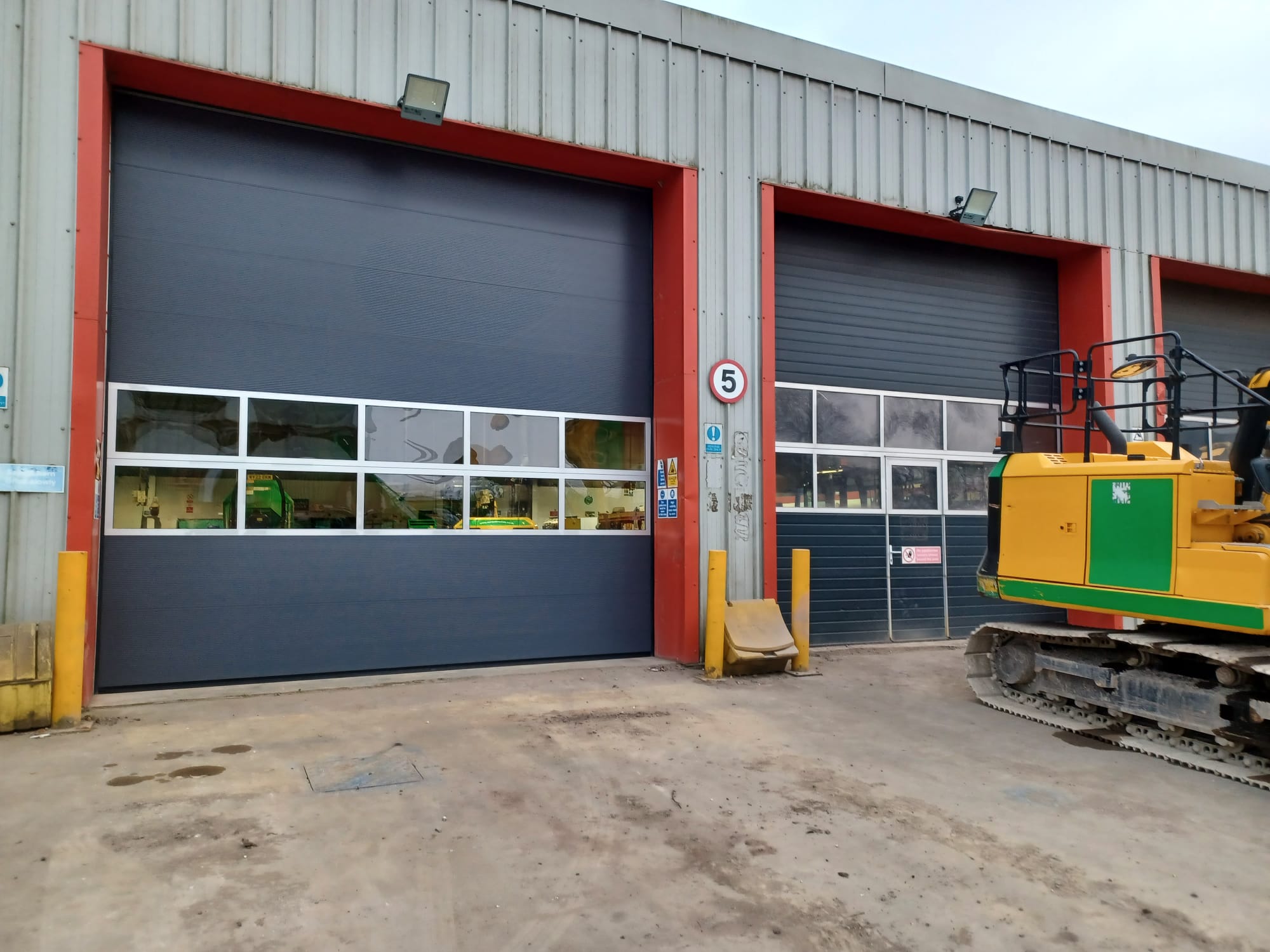
Sectional overhead doors are widely used on warehouses, factories and distribution facilities.
They can be relatively complex systems, with multiple panels, tracks, rollers, springs, cables and other components.
Regular maintenance can help identify wear or damage before it affects the operation of the door.
Automatic doors
Automatic pedestrian doors are often found in offices, retail premises, healthcare facilities and public buildings.
Because people use them constantly, their safety features are particularly important.
Sensors, activation devices and other components should be checked to ensure the door operates correctly and safely.
Fast action doors
Fast action doors, also known as high-speed doors, are designed for environments where rapid opening and closing is important.
They are found in manufacturing, logistics and temperature-controlled environments.
Because they can operate frequently throughout the day, maintenance is particularly important.
Steel set doors
Even a relatively simple commercial door should not necessarily be ignored.
Fire-rated, security and steel doors may have important roles in protecting people, property and access points.
Hinges, closers, locks, frames and other components can all require attention.
What Happens During a Door Service?
The exact process will depend on the type of door.
However, a professional service will typically involve checking the door’s general condition and operation.
An engineer may inspect:
- Door panels or curtains
- Tracks and guides
- Hinges and rollers
- Springs and cables
- Motors and drive systems
- Electrical connections
- Locks and locking mechanisms
- Safety edges
- Photocells and sensors
- Emergency release mechanisms
- Control panels
- Fixings and structural components
The engineer may also clean, lubricate or adjust components where appropriate.
Any defects or worn parts should be identified and reported.
If a repair is required, it is important that the issue is understood before the door is returned to normal use.
What Are the Warning Signs That a Commercial Door Needs Attention?
You don’t necessarily have to wait until the next scheduled service to report a problem. If a commercial door starts behaving differently, it is worth getting it checked.
Warning signs can include:
The door is making unusual noises
Grinding, squeaking, banging or rattling noises can indicate that something is wearing or becoming misaligned.
Don’t assume the noise will disappear.
It may be an early warning of a larger problem.
The door is moving more slowly
If a door that normally opens quickly starts to move noticeably slower, there could be an issue with the motor, mechanism or another component.
The door is struggling to open or close
A door that hesitates, sticks or appears to be struggling should be investigated.
Continuing to use it could potentially make the problem worse.
The door is not closing properly
This can create obvious security concerns.
A commercial door that does not close or lock correctly can leave a building or restricted area vulnerable.
Safety features are not working correctly
If a sensor, safety edge or other protective device appears faulty, the door should be assessed promptly.
Safety systems are there for a reason.
They should never be ignored.
There is visible damage
Impact damage is relatively common in busy industrial environments
Forklifts, pallet trucks and delivery vehicles can all cause damage to doors and surrounding structures.
Even apparently minor damage can affect the operation of a door.
Why Preventative Maintenance Makes Sense
There are two approaches to commercial door maintenance.
Reactive maintenance means waiting for something to go wrong and then arranging a repair.
Preventative maintenance means carrying out regular inspections and servicing to identify problems before they result in a failure.
Neither approach eliminates the possibility of breakdowns.
However, preventative maintenance can help reduce the risk of unexpected failures.
It also makes maintenance costs easier to plan.
For facilities managers, that can be a significant advantage.
An unexpected door failure can result in emergency call-outs, disruption to operations and potentially expensive replacement parts.
A planned maintenance programme is generally much easier to manage.
Commercial Door Servicing and Workplace Safety
Safety should be one of the main reasons for maintaining commercial doors.
Many commercial doors are powered and can be large, heavy pieces of equipment.
A fault with the door or its safety systems could potentially create a risk to employees, visitors, contractors or members of the public.
Employers and those responsible for workplaces have duties relating to the safety and maintenance of equipment.
The specific requirements will depend on the type of door and how it is used.
Facilities managers should therefore ensure that appropriate inspection and maintenance arrangements are in place for the doors on their sites.
It is also important to keep records of maintenance and repairs.
Good documentation can help demonstrate that appropriate maintenance procedures are being followed.
Keeping Records of Door Maintenance
Maintenance records are easy to overlook.
Keeping a record of servicing, inspections, repairs and identified defects provides a useful history for the site.
It can help Facilities Managers understand which doors are experiencing recurring problems.
It can also help with budgeting and future replacement decisions.
For example, if a particular roller shutter has required several significant repairs over the last couple of years, it may make more financial sense to replace it rather than continue spending money keeping an ageing door operational.
Records also make it easier to demonstrate that maintenance has been carried out.
Surrounding Areas
Servicing the door itself is important.
But the surrounding environment matters too.
The area around a commercial door should be kept clear of obstructions.
Vehicles, pallets, stock and equipment should not interfere with the operation of the door.
Loading bays can become particularly busy, so it is worth considering how traffic and pedestrian movements interact with the door.
Damage caused by vehicles is another common issue.
If a door is regularly being hit by forklifts or delivery vehicles, the answer may not simply be to keep repairing the door.
It may be worth looking at the layout of the area and considering additional protection such as barriers or bollards.
Sometimes the best maintenance solution is to prevent it from happening in the first place.
When Should You Replace a Door?
Regular servicing can extend the life of a commercial or industrial door.
But there comes a point when replacement may be more sensible than continued repair.
There are several factors to consider.
How old is the door? Is it becoming increasingly unreliable? Are replacement parts still readily available? Has the door suffered significant damage? Are repairs becoming more frequent? Is the door still suitable for the way the building is being used? And, importantly, does it still provide the level of security, safety and performance required by the business?
A door that is regularly breaking down may be costing more than you realise.
There is the cost of repairs and callouts, but also the less obvious cost of disruption.
If a loading bay is unavailable for several hours, for example, the impact can extend well beyond the repair bill.
How Often Should Your Commercial Doors Be Serviced?
There is no universal answer.
The appropriate servicing frequency depends on the individual door, its usage, its environment and the risks associated with failure.
The best approach is to establish a planned maintenance programme based on those factors and the manufacturer’s recommendations.
Don’t wait for a door to stop working.
By that point, you have already moved from preventative maintenance to reactive repair.
Regular professional servicing can help identify developing faults, maintain safety systems, reduce unexpected breakdowns and extend the working life of your doors.
And when you have multiple doors across a commercial or industrial site, having a planned programme can make the whole process much easier to manage.
At SDG Access, we provide commercial and industrial door installation, servicing, maintenance and repair for businesses across the UK.
Our experienced team can assess your existing doors and help you establish an appropriate maintenance programme based on your site and how your doors are used.
Whether you need routine servicing, an urgent repair or advice on replacing an ageing commercial door, getting professional advice can help keep your site safe, secure and operational.