Emergency Callout
  Get in Contact
  Get Your Free Quote
 When businesses think about reducing energy consumption, doors probably aren’t the first thing that comes to mind.
Heating, insulation, lighting and machinery tend to get most of the attention. Yet in warehouses, factories, distribution centres and other commercial buildings, doors can play a surprisingly important role in energy efficiency. Large industrial doors can be opened and closed dozens, or even hundreds, of times a day. Every time one is opened, there is an opportunity for heated or cooled air to escape.
That might not sound like a major issue when you consider one door opening for a few seconds. But over the course of a working day, those seconds can quickly add up. And when a large opening is involved, the amount of air being exchanged can be significant.
For businesses looking to reduce energy consumption and keep heating costs under control, it is therefore worth taking a look at how industrial and commercial doors are being used.
How do Industrial and Commercial Doors Affect Energy Efficiency?
The basic principle is straightforward. Most industrial buildings have a difference between the temperature inside and outside. During the colder months, a warehouse or factory may be heated to provide a comfortable environment for employees, protect stock or maintain suitable conditions for equipment and production processes.
Whenever a large door opens, some of that warm air escapes and colder outside air enters. The heating system then has to work harder to bring the internal temperature back to the required level.
The opposite can happen during warmer weather. Buildings with air conditioning rely on keeping cool air inside. Opening a large door allows that cooler air to escape while warmer air enters from outside, increasing the workload on the cooling system.
For a small pedestrian entrance, the effect may be relatively minor. For a large loading bay that is constantly being used throughout the day, however, the cumulative effect can be much greater.
The Problem with Frequently Opened Doors
Of course, doors need to be opened. That is what they are there for.
A warehouse needs to move goods in and out. A factory needs to allow forklifts and vehicles to pass between different areas. Distribution centres may have vehicles arriving and departing throughout the day. Trying to keep every door closed all the time simply isn’t practical.
The important consideration is how long the door remains open and whether it is operating in the most efficient way possible.
Consider a busy loading bay where a large door is opened every few minutes. If the door takes a significant amount of time to open and close, or is regularly left open between vehicle movements, the building can be exposed to outside temperatures for a surprisingly large proportion of the working day.
This is where the specification of the door becomes important. A system that opens and closes quickly, closed automatically when it is no longer needed and is appropriately sized for the traffic using it can help reduce unnecessary heat loss without getting in the way of normal operations.
Fast Action Doors Can Help Reduce Heat Loss
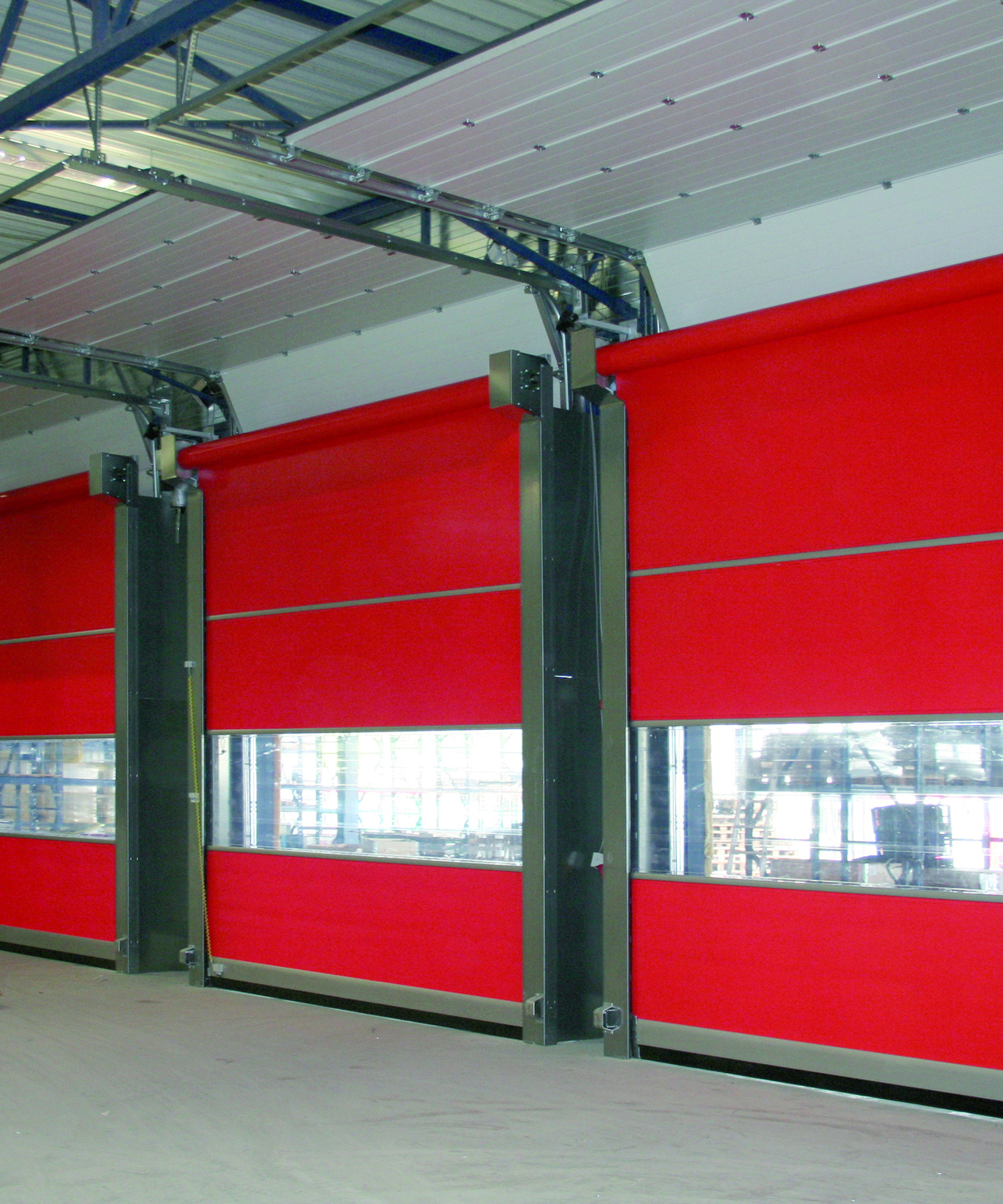
Fast action doors, also known as high-speed doors, are particularly useful in environments where industrial openings are used frequently.
As the name suggests, they are designed to open and close quickly. This reduces the amount of time that an opening is exposed to external conditions and can be particularly beneficial in warehouses, factories and distribution facilities where forklifts, vehicles and employees are constantly moving through the building.
There is a practical benefit here as well as an energy-saving one. Faster doors can improve traffic flow, reduce waiting times and help prevent employees or vehicle operators from leaving doors open simply because they are waiting for them to operate.
For a busy site, that combination can be valuable. The door gets out of the way quickly, the opening is exposed for less time, and the movement of people and goods can become more efficient.
Automatic Doors and Energy Efficiency
Automatic doors can also contribute to energy efficiency, particularly at busy pedestrian entrances.
A manually operated door can easily be left open longer than necessary. Someone might prop it open while carrying equipment, leave it open while waiting for another person or simply forget to close it after passing through. Over time, these small habits can contribute to unnecessary heat loss.
An automatic door removes much of this uncertainty. It opens when someone needs to pass through and closes again afterwards, helping to keep the internal environment separated from outside conditions.
There are also situations where the way an automatic door operates can be adjusted to suit the building. For example, an entrance may not need to open to its full width every time someone walks through it. Reducing the opening width where appropriate can limit the amount of heated or cooled air escaping while still providing a convenient entrance for staff and visitors.
Sectional Overhead Doors and Insulation
Not every industrial door needs to operate at high speed. In many warehouses, workshops and industrial buildings, sectional overhead doors can provide an effective combination of security, durability and thermal performance.
Insulated sectional doors use panels designed to reduce the transfer of heat between the inside and outside of the building. This can be particularly useful in premises where maintaining a consistent internal temperature is important.
The overall performance of the door will depend on its specification, installation and the building itself. Nevertheless, choosing an appropriately insulated door can form part of a wider strategy to improve the thermal efficiency of an industrial or commercial property.
It is also worth considering what surrounds the door. Even a well-insulated door can have limited impact if there are significant gaps around the opening, damaged seals or poorly insulated sections of the building.
What About Roller Shutters?
Roller shutters are widely used across commercial and industrial premises, from warehouses and factories to retail units, storage facilities and car parks. They provide a practical combination of security, durability and ease of operation, making them suitable for a wide range of applications.
When closed, a roller shutter provides a physical barrier between the internal environment and outside conditions. However, the level of thermal performance can vary depending on the type of shutter specified.
For businesses where energy efficiency is a priority, insulated roller shutters incorporate insulated slats designed to reduce heat transfer through the door. This can help businesses retain more heat inside their premises during the colder months and reduce the amount of external heat entering during warmer weather.
Insulated roller shutters can be particularly useful for buildings where maintaining a more consistent internal temperature is important, such as warehouses, workshops, industrial units and commercial premises. They can also provide the added benefits of improved security and, depending on the specification, reduced noise transmission.
However, just like any other industrial door, the way a roller shutter is used is important. A well-insulated shutter that is left open for long periods will obviously provide less protection from external temperatures than one that closes promptly after use.
This is why businesses should consider the complete system rather than simply the door itself. The type of shutter, level of insulation, automation, sensors, controls and operating procedures can all influence how effectively a roller shutter can help manage heat loss.
For some applications, an insulated roller shutter could therefore be a relatively simple way to improve the thermal performance of an existing opening without compromising the security and practicability that businesses expect from a roller shutter.
The Importance of Automatic Closing
It sounds obvious, but an industrial door cannot help with energy efficiency while it is sitting open.
This can be a particular problem in busy environments where there is a constant stream of people, vehicles and goods moving through an opening. Someone opens the door to allow a forklift through, becomes distracted by another task and the door remains open. Another employee then assumes somebody else will close it.
Before long, a large opening may have been exposed to outside temperatures for several minutes.
Automatic closing can help prevent this. Doors can be configured to close after a suitable period, reducing the likelihood of them being left open unnecessarily. Sensors and other control systems can also help ensure that doors open when they are needed rather than remaining open continuously.
It is a relatively simple principle: the less time a large opening is exposed to the outside environment, the less opportunity there is for heated or cooled air to escape.
Vehicle and Pedestrian Traffic Matters
One of the most important considerations when choosing an industrial door is understanding how the opening is actually going to be used.
Is it primarily a pedestrian entrance? Will forklifts be passing through every few minutes? Is it used by cars and vans, or does it need to accommodate large HGVs? Perhaps it needs to handle a mixture of all of these.
There is no universal industrial door that is perfect for every application. A solution that works well for a busy pedestrian entrance may be completely unsuitable for a large warehouse loading bay.
Traffic patterns should therefore form part of the decision-making process. A large door may not need to open to its maximum width every time a person walks through it, for example, while a vehicle entrance needs enough clearance to allow safe and efficient movement.
Getting the specification right can help businesses balance operational requirements with energy efficiency.
Could Your Door Controls Make a Difference?
Modern industrial doors can incorporate a wider range of control systems, including sensors, push buttons, remote controls, automatic closing functions and safety systems.
Used correctly, these controls can help ensure that a door operates when it is needed rather than remaining open unnecessarily.
This can be particularly useful on busy sites. Sensors can detect approaching vehicles or pedestrians and trigger the door to open automatically. Once the opening is clear, the door can close again without relying on someone remembering to operate it.
Businesses may also benefit from considering how doors are used at different times of the day. A warehouse might have very different requirements during normal operating hours compared with overnight periods. Adjusting controls and operating procedures accordingly can help avoid unnecessary exposure.
Door Maintenance Matters Too
Energy efficiency isn’t simply about buying a new door.
A poorly maintained door may not close correctly. Seals can become damaged, components can wear and the door may become slower or less reliable. Small problems can gradually develop without being noticed, particularly when a door continues to function well enough for day-to-day operations.
Regular inspections, maintenance and servicing can help identify these issues before they become more serious.
For businesses that rely heavily on industrial doors, planned maintenance also makes good commercial sense. A door that fails completely can cause disruption, delays and potentially significant repair costs. Keeping the system properly maintained can help extend its working life while ensuring that it continues to operate as intended.
Energy Efficiency Isn’t Just About the Door
It is important to take a wider view when considering energy efficiency.
An insulated industrial door can help reduce heat transfer, but its effectiveness will be influenced by the rest of the building. Damaged seals, gaps around the opening, poorly insulated walls or an inefficient heating system can all undermine the overall result.
The way employees use the doors matters too.
If doors are routinely left open, even the most energy-efficient system will struggle to deliver its full potential. Simple changes to operating procedures can therefore be just as valuable as investing in new equipment.
For businesses assessing their energy use, it makes sense to look at the whole picture: the door, the building around it, the traffic using the opening and the way the system is operated.
Which Industrial Door is Best for Energy Efficiency?
There isn’t one simple answer.
The right solution depends on the building, the size of the opening, the environment and how frequently the door is being used.
A high-speed door could be an excellent option for a busy warehouse or production facility where vehicles are constantly moving through an opening. An insulated sectional overhead door may be better suited to a building where thermal performance and security are key considerations. Automatic doors can work particularly well at busy pedestrian entrances, while roller shutters provide a practical solution across a wide range of commercial and industrial applications.
In some cases, using different door types across the same site can be the most effective approach. A warehouse, for example, might use a high-speed door for frequent forklift movements while having a separate automatic entrance for pedestrians.
The important thing is to match the door to the job.
Can Energy-Efficient Doors Save Money?
Potentially, yes. But businesses should be realistic about what a new industrial or commercial door can achieve.
The potential energy savings will depend on several factors, including the size of the opening, how frequently it is used, the internal and external temperatures, the building’s heating or cooling requirements, the existing door and how long it typically remains open.
The more frequently a large opening is used, the greater the potential benefit of improving its operation.
This is why it can be useful to assess how a door is actually being used before deciding on a replacement. Rather than simply replacing an existing door with something similar, businesses can look at whether a different type of system, faster operation or improved controls could provide a better solution.
Small Changes Can Make a Difference
Energy efficiency can feel like a huge challenge for businesses. There are heating systems to consider, insulation, lighting, machinery, renewable energy and a host of other factors.
Doors might not seem particularly significant in comparison.
But on a busy industrial site, they are constantly interacting with the outside environment. A door that opens quickly, closes automatically, provides good insulation and is properly maintained can contribute to a more energy-efficient building.
And there can be other benefits too. Better traffic flow, improved security, greater convenience and reduced downtime can all come from choosing the right door and operating it correctly.
Energy efficiency doesn’t always require a dramatic change. Sometimes, it is about identifying the areas where energy is being lost and making sensible improvements.
Is it Time to Look at Your Industrial and Commercial Doors?
If your business is looking for ways to reduce energy consumption, it is worth including industrial and commercial doors in the conversation.
Start by asking some straightforward questions. How often are your doors opened? How long do they stay open? Are they closing automatically? Are they operating as quickly as they should? Are the seals and surrounding areas in good condition? And could a different type of door be better suited to the way your building is being used?
At SDG Access, we supply and install a wide range of industrial and commercial door systems, including roller shutters, sectional overhead doors, fast action doors, automatic doors, steel set doors and spiral doors. We can help businesses consider the most appropriate solution for their building, traffic requirements and security needs.
Every site is different, so there is no single answer when it comes to energy-efficient industrial doors. But by looking carefully at how your doors operate and choosing the right system for the job, you can potentially reduce unnecessary heat loss while creating a safer, more efficient and more practical working environment.