Emergency Callout
 Get in Contact
 Get Your Free Quote
Walk into a busy distribution centre and there is a lot going on.
Forklifts are moving pallets between storage and loading bays. HGVs are arriving and leaving. Goods are being picked, packed and dispatched. Staff are moving between different areas of the building while automated systems keep stock flowing through the operation.
Among all this activity, industrial doors can be easy to overlook.
Yet a distribution centre depends on its doors every day. They provide access for vehicles and goods, separate different working areas, help protect the building and, in many cases, play an important role in safety and security.
When they work properly, nobody gives them much thought.
When one stops working, everyone notices.
For a logistics operation, a failed industrial door can quickly become more than a maintenance problem. It can affect vehicle movements, loading schedules, staff productivity and the ability to move goods through the building.
That is why industrial doors deserve a much bigger place in the maintenance and operational plans of modern distribution centres.
Why Industrial Doors Are Important in Distribution Centres
Modern logistics is built around movement.
Goods arrive at a site, are unloaded, stored or transferred, picked and then loaded onto vehicles for their next destination. Every stage depends on access through the building.
Industrial doors provide that access.
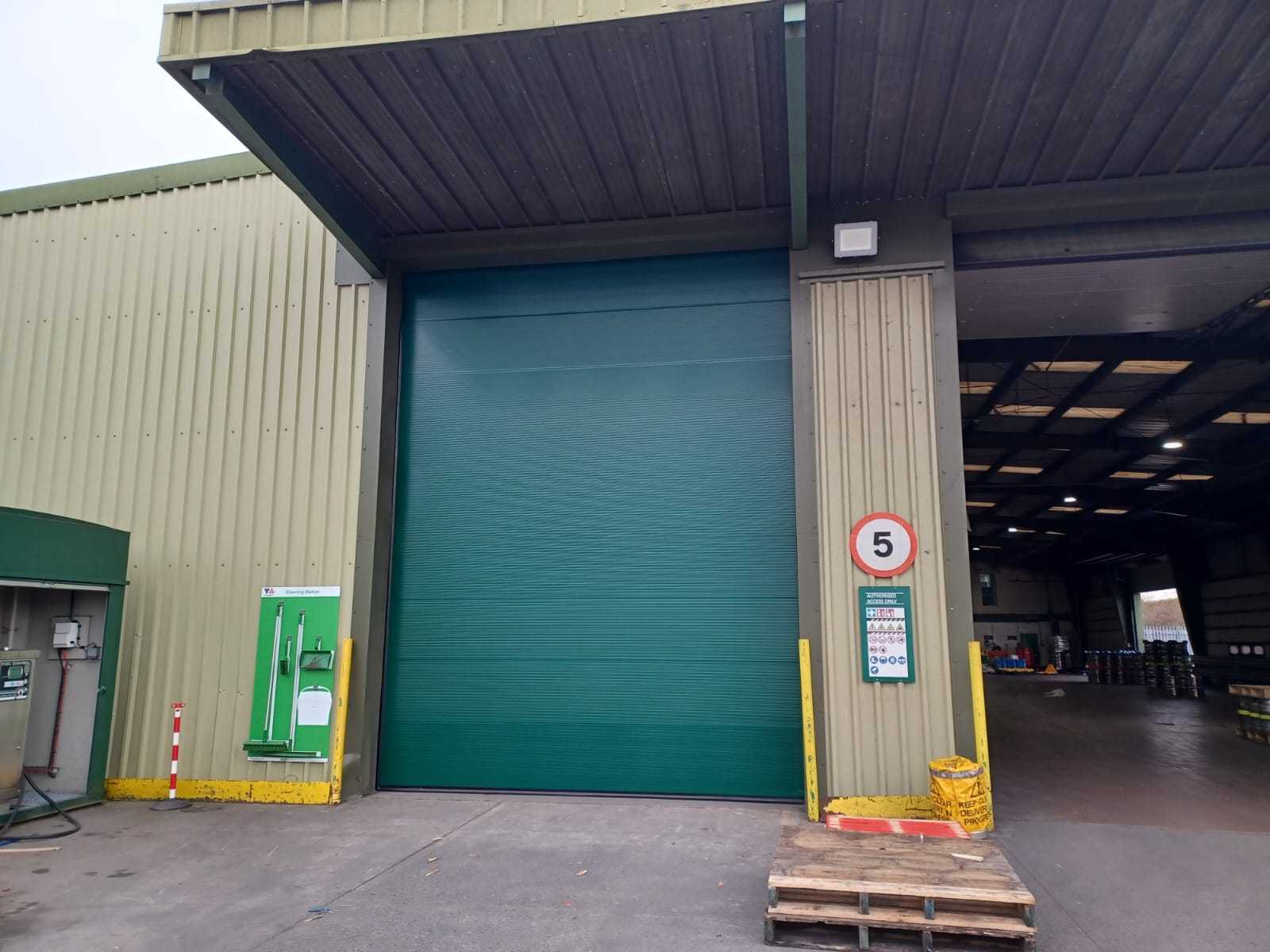
A distribution centre may have several different types of doors, depending on the building and how it operates. These can include roller shutter doors, sectional doors, high-speed doors, fire doors and doors designed specifically for loading bays.
Each one has a different purpose.
A high-speed door, also known as fast action doors, may be used between areas where forklifts and other vehicles are constantly moving. A roller shutter may secure a loading bay overnight. A sectional overhead door may provide access to a vertical loading area while also offering insulation.
The right choice depends on how the opening is used, how frequently the door operates and the environment in which it is installed.
The Door & Hardware Federation (DHF), which represents companies working across the door, hardware and industrial door sectors, recognises that industrial doors are widely used in warehouses and other commercial premises to provide access for vehicles and goods. It also highlights factors such as durability, frequency of use, opening speed, insulation and security when considering different industrial door types.
For a busy distribution centre, those details matter.
A door that is perfectly suitable for a small warehouse with limited vehicle movements may be completely unsuitable for an operation where it is opening hundreds of times every day.
How Industrial Doors Keep Goods Moving
Distribution centres operate to tight schedules.
A vehicle arrives at a loading bay. Goods need to be moved. The vehicle needs to leave so the next one can arrive.
A delay at one stage can have a knock-on effect elsewhere.
Imagine a roller shutter at a loading bay develops a fault early in the morning. The door cannot open fully and needs to be taken out of service.
The loading bay is now unavailable.
Perhaps another bay can be used. If it is already busy, though, vehicles may have to wait. Forklift routes may need to change. Staff may have to move goods further through the building. A delivery or collection can take longer than planned.
One door has created a problem across the operation.
This is why the cost of industrial door failure should not be measured only by the repair bill.
The bigger cost can be the disruption around it.
For a large distribution centre operating for long hours, even a relatively short period of downtime can put pressure on the rest of the site.
Why Loading Bay Doors Matter in Logistics Operations
Loading bays are one of the busiest areas of many distribution centres.
They are also exposed to some of the hardest working conditions. Doors can be opened and closed repeatedly throughout the day, while forklifts, pallet trucks, vehicles and people operate around them.
This level of activity creates wear.
Loading bay doors need to be suitable for the frequency of use and the environment. They also need to be maintained properly so that problems can be identified before they become failures.
The same applies to other equipment around the loading area, including dock levellers and associated access systems.
For a logistics manager, it makes sense to look at the whole loading operation rather than treating the door as an isolated piece of equipment.
If a door is slow, unreliable or regularly out of service, it can affect the performance of the loading bay itself.
Industrial Door Maintenance and Preventative Maintenance
Industrial doors are mechanical systems. Like any other heavily used equipment, they require maintenance.
This sounds obvious, but maintenance can sometimes become reactive.
A door breaks, someone calls a contractor and the repair is arranged.
The door works again and everyone moves on.
That approach can work for an occasional fault, but it can also mean the same problems keep returning.
Planned preventative maintenance gives site managers a chance to identify wear and potential faults before they become a bigger issue.
The DHF states that all doors and gates require some form of maintenance, with the frequency depending on the type of door and how it is used. It also makes clear that the person in control of the premises has an important responsibility for ensuring essential maintenance is carried out.
For a busy distribution centre, that means maintenance schedules should reflect actual usage.
A door opening a handful of times each day does not face the same demands as one operating continuously during a busy shift.
DHF provides best practice guidance covering the maintenance, repair and modification of industrial doors.
Industrial Door Safety in Distribution Centres
Industrial door maintenance is not only about keeping the operation moving.
Safety is equally important.
Distribution centres can be busy environments, with pedestrians, forklifts, HGVs and automated equipment operating in close proximity.
A faulty door can create additional risks.
For example, a door may fail to stop correctly, develop a problem with its operating mechanism or have damaged components that affect safe operation.
There are also specific requirements around workplace doors and gates.
The DHF notes that the Workplace (Health, Safety and Welfare) Regulations 1992 include requirements relating to the safe maintenance of doors and gates, including vertically moving doors. It also highlights the importance of protection against a vertically moving door falling back.
The responsibility does not simply disappear because a door is old.
The DHF’s guidance makes an important point for owners and managers: a system being compliant when it was originally installed does not automatically mean that it remains compliant throughout its life. Its condition and safety need to be considered over time.
That is particularly relevant in older distribution centres where industrial doors may have been installed many years ago.
When Should Older Industrial Doors Be Replaced?
Many warehouses and distribution centres in the UK are not new buildings.
Some have been operating for decades. The demands placed on the building may also have changed considerably since the original doors were installed.
A warehouse that once handled a few hundred vehicle movements each week may now be operating around the clock.
A door that was suitable when it was installed may now be experiencing much higher levels of use.
That does not automatically mean the door needs replacing. It does mean its condition and suitability should be reviewed.
Maintenance records can be useful here. They can show which doors are generating repeated faults, which components are wearing more quickly and where repair costs are starting to increase.
At some point, repeatedly repairing an ageing door may make less operational sense than replacing it.
The decision should be based on the condition of the door, its usage and the impact of failure on the site.
Choosing the Right Industrial Door for a Warehouse
There is no single industrial door that is right for every distribution centre.
The right solution depends on the job the door needs to perform.
A high-speed door can be useful where rapid movement between areas is important. A roller shutter can provide a robust solution for securing openings. A sectional door may be appropriate where insulation and access requirements need to be considered together.
The environment matters too.
A chilled or temperature-controlled facility will have different requirements, depending on whether vehicles or pedestrians will use the door.
This is why industrial door specification should be considered early when a distribution centre is being designed, refurbished or adapted.
Choosing purely on initial purchase price can overlook the longer-term operational cost.
A door that costs less to install but is poorly suited to its environment may require more maintenance or suffer more downtime.
What Logistics Managers Should Look for in Industrial Doors
The condition of industrial doors should form part of the wider facilities management picture.
Regular inspections can help identify obvious signs of wear. Maintenance records can highlight recurring faults. Staff should also have a simple way of reporting problems when they notice them.
A door that is becoming slower, making unusual noises or showing visible damage may be giving an early warning.
That information is useful.
It allows the site team to investigate the problem before the door becomes unavailable during a busy shift.
It is also worth considering which doors are critical to the operation.
If one loading bay door fails, what happens?
Can another bay handle the additional traffic? How long would the affected area remain unavailable? Is there a suitable contingency arrangement?
These are operational questions as much as maintenance questions.
Warehouse Efficiency and Logistics
The importance of warehouse infrastructure is increasingly recognised across the logistics sector.
The UK Warehousing Association (UKWA) describes itself as Britain’s leading trade organisation dedicated to warehousing.
Its work around the future warehouse also highlights the importance of efficiency, automation and changing warehouse operations.
As distribution centres become more automated, reliable physical infrastructure becomes even more important.
Automated storage systems, conveyors, robotics and warehouse management systems can all improve the movement of goods. They still need a building that allows people, vehicles and products to move safely between different areas.
Industrial doors are part of that infrastructure.
A highly automated warehouse can still experience a very simple problem if a critical access door stops working.
How Industrial Doors Can Help Improve Energy Efficiency
There is another consideration for modern distribution centres: energy.
Large warehouse openings can allow significant amounts of heated or cooled air to escape whenever they are open.
This can be particularly important in temperature-controlled environments.
Door design and operating speed can help reduce the amount of time an opening remains open. Insulated doors can also play a role where maintaining internal temperatures is important.
The best approach will depend on the building and its use, but energy performance is becoming a more important consideration when industrial doors are replaced or upgraded.
For businesses looking at wider carbon reduction targets, doors should be considered alongside other building systems rather than treated as a separate issue.
Industrial Doors and Warehouse Security
Distribution centres can hold large quantities of valuable stock.
Industrial doors therefore have a role to play in site security.
A loading bay door that does not close properly, or a damaged shutter that cannot be secured, can create an obvious vulnerability.
Security needs to be considered alongside operational requirements.
A door may need to provide fast access during working hours while offering robust security when the site is closed.
This is another reason why the choice of industrial door needs to reflect the way the distribution centre actually operates.
Keeping Distribution Centres Moving With Reliable Industrial Doors
Industrial doors rarely get much attention when everything is working. That is probably a sign that they are doing their job.
But behind every distribution centre is a network of infrastructure that allows goods to move safely and efficiently. Doors are an important part of that network.
The right door, correctly specified and properly maintained, can help a loading bay operate smoothly. It can support the movement of vehicles and goods, protect the building, improve security and help maintain a safe working environment.
The key is to treat industrial doors as part of the operation rather than simply another building component.
For warehouse and logistics managers, that means understanding how each door is used, keeping maintenance up to date and dealing with early signs of problems before they turn into operational disruption.
In a sector where every loading bay, vehicle movement and delivery matters, keeping the doors working means keeping the operation moving.