Emergency Callout
 Get in Contact
 Get Your Free Quote
As temperatures drop across the UK, gates and traffic barriers face a different set of operating conditions. Rain, frost, ice, snow and strong winds can all affect how they perform. For businesses that rely on secure access to their premises, a fault can mean more than an inconvenience. Deliveries may be delayed, vehicles could be left waiting outside, and security can be compromised.
Winter problems rarely appear out of nowhere. A worn hinge, a blocked drainage channel or a poorly maintained safety sensor might go unnoticed during milder weather. When temperatures fall and conditions deteriorate, that small problem can become a much bigger one.
For facilities managers, estate managers and site operators, now is the time to check that gates and barriers are ready for the months ahead.
Why Winter Weather Puts Gates and Barriers Under Pressure
Gates are designed to operate outdoors, but that does not make them immune to the weather. Cold temperatures can affect moving components, while rain and standing water increase the risk of corrosion and electrical faults.
Ice is a particular problem. It can form around hinges, tracks, rollers and underground motor housings, restricting movement or preventing a gate from completing its normal operating cycle. A motor that has to work harder to move a gate may experience additional strain, especially if there is already wear in the mechanism.
Then there is the wind.
Strong gusts place additional pressure on gate leaves, posts, fixings and automation equipment. Solid or close-boarded swing gates can be particularly vulnerable because they present a larger surface area to the wind. If the gate is already poorly aligned or its fixings are deteriorating, winter weather can expose the weakness.
Water can cause trouble long after the rain has stopped. If drainage is poor, water may collect around underground operators or within parts of the gate mechanism. When it freezes, it can restrict movement or contribute to damage.
The result is often a gate that moves more slowly, stops unexpectedly or refuses to open or close at all.
For a distribution centre, warehouse, manufacturing site or commercial car park, the timing could hardly be worse. Winter is often a busy period, and an access failure can disrupt operations just when staff and deliveries need to get moving.
Start With a Professional Winter Service
The best way to prepare is to arrange a professional inspection before severe weather arrives, rather than waiting for the first breakdown.
The Door and Hardware Federation (DHF) provides guidance on the management, maintenance and repair of powered gates and traffic barriers. Its guidance stresses the responsibilities of the people managing these systems, including site owners, occupiers, landlords and facilities managers.
The Health and Safety Executive (HSE) also makes it clear that powered gates need regular inspection and maintenance to remain safe. This includes checking the complete system, not simply confirming that the motor still works.
A suitable service should consider the mechanical structure, electrical components, control equipment and safety devices. The engineer should check the gate's movement, alignment, hinges or rollers, fixings, drive mechanism and any signs of wear or damage. Safety systems also need to be tested properly.
The correct service interval depends on the equipment, manufacturer's instructions, operating frequency and site conditions. A barrier opening hundreds of times a day at a busy commercial entrance may need more frequent attention than a gate used only occasionally.
There is no single servicing interval that suits every installation. For many commercial sites, a planned preventative maintenance (PPM) contract helps ensure inspections take place at the appropriate intervals, with faults identified before they cause disruption.
It also gives facilities managers a record of work completed, defects found and any repairs recommended.
Different Gates Face Different Winter Problems
Not every gate behaves in the same way when temperatures fall. Understanding the type of installation on your site helps you identify where attention is needed.
Sliding gates
Sliding gates are common at industrial premises, distribution centres and secure commercial sites. They provide controlled access without requiring a large swing area, but their operation depends on the gate travelling freely along its intended path.
Tracks can collect leaves, mud, grit and other debris during autumn. Add rain, frost or snow, and the build-up can restrict movement. Ice around the track or guide rollers may prevent the gate from moving smoothly.
The drive rack, rollers, bearings and end stops also need to be checked. Worn components or poor alignment can increase resistance and place extra strain on the drive system.
There is a safety issue here, too. A sliding gate must be adequately supported and restrained throughout its travel. DHF guidance highlights the importance of suitable supports, guides and end stops to prevent a gate travelling beyond its intended position and potentially falling.
Before winter, make sure the travel area is clear, drainage is working and the gate moves smoothly. Do not assume that a gate which opens and closes successfully has no underlying problem.
Swing gates
Swing gates can be affected by wind, frost and stiffening hinges. Strong winds may push against the gate leaves, increasing the load on the hinges, posts and automation arms.
If the gate is close-boarded or has a solid infill, wind pressure can be significant. An operator that manages perfectly well in calm weather may struggle when gusts are pushing against the gate.
Cold weather can also expose existing friction in hinges and linkages. If a gate is already difficult to move, forcing it to operate can make the problem worse.
Check for movement in the hinges, deterioration around the posts, loose fixings and signs that the gate is sagging. Any adjustment to the motor's force settings should be carried out by a competent engineer, with the safety of the complete system checked afterwards.
Cantilever gates
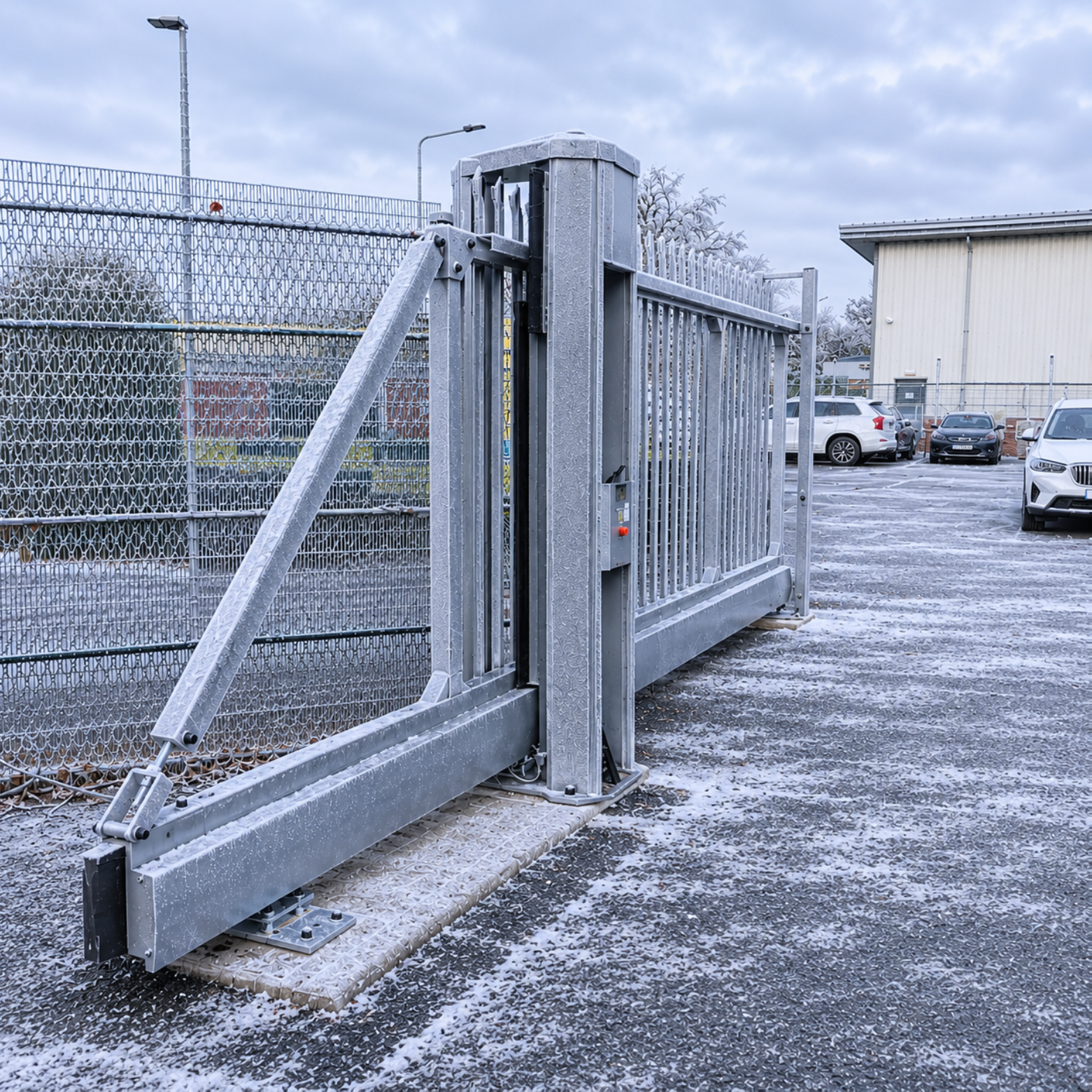
Cantilever sliding gates are widely used at industrial sites and commercial premises where a reliable, secure entrance is essential. Unlike conventional sliding gates, they do not run along a ground track. Instead, the gate is supported by a system of rollers and a counterbalance arrangement, allowing it to slide across the entrance without touching the ground.
This design removes some of the problems associated with ground tracks, particularly the build-up of mud, leaves and standing water. It does not make cantilever gates immune to winter weather, though.
Cold temperatures, ice and moisture can still affect the roller assemblies, bearings, guide brackets and drive mechanism. Snow and ice can also accumulate beneath the gate or around its supporting structure, potentially restricting movement if the clearance is insufficient.
The supporting posts, foundations and roller assemblies should be checked for signs of wear, movement or corrosion. Any deterioration in these components can affect the gate's alignment and place additional strain on the motor.
Wind is another consideration. Large cantilever gates can have substantial surface areas, meaning strong gusts may place additional pressure on the gate structure and supporting equipment.
Before winter, check that the gate travels smoothly, the roller assemblies are in good condition and the counterbalance structure is secure. The drive system and safety devices should also be inspected by a competent engineer.
A cantilever gate that starts to judder, move unevenly or make unusual noises should be investigated rather than left until it stops working altogether.
Automatic Rising Arm Barriers
Traffic barriers are widely used at car parks, business parks, hospitals, residential developments and distribution facilities. Their frequent operation makes routine servicing particularly important.
During winter, moisture can affect electrical connections and control equipment. Cold weather may also reveal problems with worn moving parts or components that are already approaching the end of their service life.
The boom arm, counterbalance mechanism, pivots, drive system and controls should all be checked. Safety devices must work correctly, particularly where pedestrians and vehicles use the same entrance.
A barrier that fails to rise can cause queues to build up outside a site. One that fails to lower can leave a controlled entrance unsecured. Neither is a good situation during a busy shift change or a period of heavy deliveries.
Where access is essential, site managers should also know what to do if the barrier fails, including how to manage vehicle movements safely while repairs are arranged.
Safety Sensors Must Work in All Weather
A gate that opens and closes is not necessarily a safe gate.
Automatic gates may use photocells, pressure-sensitive safety edges and other devices to detect obstacles or prevent people from being struck, trapped or crushed. These systems must continue to work as intended throughout winter.
Snow, frost, dirt and condensation can affect photocells and obscure their lenses. Depending on the system, this may prevent the gate from operating or interfere with the detection of an obstruction.
Safety edges, wiring and control systems also need inspection. Moisture, physical damage and deteriorating connections can affect performance.
The HSE has published guidance on powered gates following serious and fatal incidents involving people trapped or crushed by moving gates. Its advice explains that safety depends on the design and installation of the complete system, as well as how it is maintained over time.
The consequences of neglect can be severe. In incidents described in HSE safety notices, children died after becoming trapped in powered gates because their presence was not detected and the closing forces were too high.
These incidents were not all caused by winter weather. They demonstrate why routine maintenance must include safety testing, rather than focusing solely on whether the gate moves.
For businesses, this matters wherever staff, delivery drivers, contractors, visitors or members of the public could encounter an automatic gate.
Never bypass a safety device or increase a gate's operating force simply to make it work through ice or resistance. If the gate behaves unexpectedly or a safety feature fails, take it out of use where necessary and arrange a competent inspection.
What Can UK Businesses Learn from Colder Countries?
In countries such as Sweden, Finland and Norway, snow and prolonged freezing temperatures are a routine part of winter planning. Equipment exposed to these conditions needs to be suitable for the local climate, and access routes must be kept clear.
The useful lesson for UK businesses is not that every gate needs specialist winter equipment. It is that the surrounding environment and the operating conditions need to be considered as part of maintenance planning.
For example, a site that experiences regular snowfall needs a clear procedure for removing snow from sliding gate tracks and the area in which swing gates travel. Snow pushed to the side of a road by clearing equipment must not be allowed to accumulate where it can obstruct a gate.
Similarly, drainage needs to be considered before freezing weather arrives. Water that collects around a gate can freeze into an obstruction, while ice can prevent moving parts from travelling freely.
In colder climates, equipment may also be specified with suitable low-temperature operating limits, weather protection or heating where the application requires it. These measures should be selected in line with the manufacturer's recommendations, not added as a quick fix.
UK sites can adopt the same approach. If a gate is located in an exposed position, operates around the clock or serves a critical entrance, the maintenance plan should reflect those demands.
A site in Lincolnshire, for instance, may face freezing fog, exposed winds and overnight frost. A coastal site may have additional exposure to wind-driven rain and corrosive conditions. The details vary, but the principle is the same: prepare for the conditions the equipment will face.
Practical Checks to Carry Out Before Winter
A professional service is essential, but site teams can also carry out simple visual checks as part of their normal facilities management routine.
Keep the operating area clear. Remove fallen leaves, mud and loose debris from tracks, hinges, drainage points and the surrounding area. After snowfall, clear obstructions from the gate's travel path using a safe method.
Look for visible damage. Check for loose fixings, damaged cables, corrosion, sagging gate leaves and signs of impact. Do not remove covers or attempt repairs unless you are competent and authorised to do so.
Check for changes in operation. Slower movement, unusual noises, repeated stopping or a gate that no longer completes its cycle can indicate a fault. Do not keep resetting the system without finding the cause.
Keep safety devices clean. Inspect accessible photocells for dirt, frost or snow and clean them in accordance with the manufacturer's instructions. A visual check does not replace professional testing of the safety system.
Review emergency arrangements. Staff responsible for the site should know how to respond to a power failure or gate breakdown. Manual release procedures should be understood and documented, but only used by authorised people following the correct instructions.
Record faults and repairs. A simple maintenance log helps identify recurring problems and gives managers a clearer picture of the condition of the equipment.
These checks should form part of the site's normal maintenance routine. They are not a substitute for professional servicing, and staff should never put themselves at risk by working on moving machinery or attempting to free a jammed gate.
The Cost of Putting Maintenance Off
It is tempting to delay servicing when a gate appears to be working normally. Budgets are tight, and there is always another job competing for attention.
But an unplanned failure can cost more than a scheduled visit.
A faulty entrance may delay deliveries, interrupt vehicle movements or require staff to supervise access manually. A gate that cannot secure a site may leave equipment, stock or vehicles more exposed. Emergency repairs can also be more disruptive, particularly when a fault occurs outside normal working hours.
There is no reliable single figure for the cost of a winter gate failure. It depends on the site, the equipment and the consequences of losing access. For a busy distribution operation, even a short interruption can affect several parts of the working day.
The safety implications are more serious still. The HSE states that owners and occupiers of commercial premises must ensure powered gates are safe and properly maintained. Depending on the site and the people affected, duties may arise under workplace safety regulations and the Health and Safety at Work etc. Act 1974.
Landlords and managing agents also have responsibilities where gates form part of premises they manage. If a competent contractor identifies a dangerous fault, prompt action is needed.
A maintenance contract does not remove those responsibilities, but it can help managers plan inspections, keep records and deal with defects in a more controlled way.
Get Your Gates and Barriers Ready for Winter
Winter preparation is about more than preventing a motor from stopping on a frosty morning. It means checking that the complete gate or barrier system can operate reliably and safely as conditions change.
Start by reviewing your servicing records. Identify equipment that is overdue for inspection, gates that have developed recurring faults and entrances where a failure would cause significant disruption.
Arrange a professional service before severe weather sets in. Make sure the inspection covers mechanical condition, electrical components, drainage and safety devices, with any defects recorded and addressed.
For facilities managers responsible for several sites, a planned preventative maintenance schedule can make this easier to manage. It provides a structured approach to inspections and helps reduce the risk of important checks being missed during a busy period.